Библиографическое описание:Новый метод получения прозрачных проводящих пленок оксида индия (III) и оксида индия-олова : научное издание / Н. П. Фадеева [и др.]. - Текст : непосредственный // Журнал Сибирского федерального университета. Серия: Химия = JOURNAL OF SIBERIAN FEDERAL UNIVERSITY-CHEMISTRY. - 2021. - Т. 14, № 1. - С. 45-58. - Cited Reference Count: 36. - This work was supported by the Russian Foundation for Basic Research (Grant No. 18-33-00504) and a scholarship from the President of the Russian Federation (SP-2235.2019.1). We are grateful to the Centre of collective usage of the Siberian Federal University and Krasnoyarsk Regional Center of Research Equipment of Federal Research Center "Krasnoyarsk Science Center SB RAS"., Russian Foundation for Basic ResearchRussian Foundation for Basic Research (RFBR). 18-33-00504. - ISSN 1998-2836, DOI 10.17516/1998-2836-0215.
Аннотация:В работе получены седиментационно устойчивые золи гидроксидов индия (III) и олова(IV) методом анионообменного синтеза, заключающимся в обменной реакции между ОН-ионами анионообменной смолы и анионами металлосодержащих растворов. Синтезированные гидрозоли использованы для получения проводящих пленок оксида индия (III) In<sub>2</sub>O<sub>3</sub> и оксида индия, легированного оловом In2O3:Sn, с поверхностным сопротивлением 4 кОм/кв, толщинами 200- 500 нм и прозрачностью более 85 %. Подобраны режимы нанесения прекурсоров на стеклянные подложки модифицированным спрей-методом и методом центрифугирования. Пленки исследованы с помощью РФА, СЭМ, оптической микроскопии и спектрофотометрии.
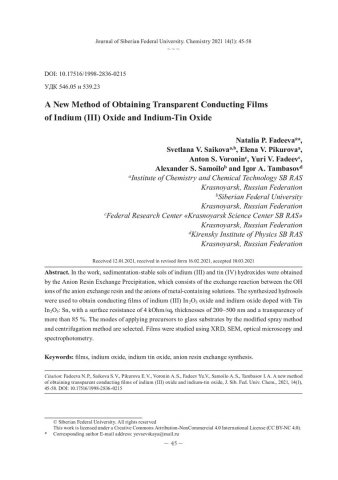
In the work, sedimentation-stable sols of indium (III) and tin (IV) hydroxides were obtained by the Anion Resin Exchange Precipitation, which consists of the exchange reaction between the OH ions of the anion exchange resin and the anions of metal-containing solutions. The synthesized hydrosols were used to obtain conducting films of indium (III) In<sub>2</sub>O<sub>3</sub> oxide and indium oxide doped with Tin In<sub>2</sub>O<sub>3</sub>: Sn, with a surface resistance of 4 kOhm/sq, thicknesses of 200-500 nm and a transparency of more than 85 %. The modes of applying precursors to glass substrates by the modified spray method and centrifugation method are selected. Films were studied using XRD, SEM, optical microscopy and spectrophotometry.
In the work, sedimentation-stable sols of indium (III) and tin (IV) hydroxides were obtained by the Anion Resin Exchange Precipitation, which consists of the exchange reaction between the OH ions of the anion exchange resin and the anions of metal-containing solutions. The synthesized hydrosols were used to obtain conducting films of indium (III) In2O3 oxide and indium oxide doped with Tin In2O3: Sn, with a surface resistance of 4 kOhm/sq, thicknesses of 200-500 urn and a transparency of more than 85 %. The modes of applying precursors to glass substrates by the modified spray method and centrifugation method are selected. Films were studied using XRD, SEM, optical microscopy and spectrophotometry.
Издательство:Сибирский федеральный университет, Красноярск
Источник:Журнал Сибирского федерального университета. Серия: Химия
Выпуск:Т. 14, № 1
Номера страниц:45-58
Держатель оригинала документа:Институт физики им. Л. В. Киренского ФИЦ КНЦ СО РАН, Институт химии и химической технологии ФИЦ КНЦ СО РАН, Сибирский федеральный университет, ФИЦ «Красноярский научный центр СО РАН»
Количество экземпляров:
Твёрдая копия издания отсутствует в фонде библиотеки